



Description
Product Overview
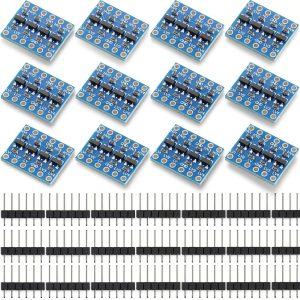
The SparkFun Logic Level Converter is a compact bi‑directional voltage translation board designed for hobbyists, engineers, and professionals who need reliable signal compatibility between differing logic families. Measuring just 0.63 × 0.52 in and weighing under one ounce, the board provides a low‑profile solution that can be integrated into tight enclosures or stacked on breadboards without obstructing other components. It supports automatic stepping of 5 V signals down to 3.3 V while simultaneously stepping 3.3 V signals up to 5 V on the same channel, eliminating the need for separate converters. In addition to the primary 5 V/3.3 V range, the converter also works with 2.8 V and 1.8 V logic levels, making it versatile for a wide array of microcontrollers, sensors, and communication modules.
The board features four independent channels, each with dedicated high‑voltage (HV) and low‑voltage (LV) pins, allowing parallel conversion of multiple signals. Power is supplied via two pins, HV and LV, which are connected to the respective voltage rails of your system, ensuring stable operation across a broad temperature range. The robust PCB layout includes protective resistors and MOSFETs that guard against over‑voltage and reverse‑current conditions, providing long‑term durability for demanding projects. The component placement follows SparkFun’s design‑for‑manufacturing guidelines, resulting in consistent solderability and minimal assembly time.
Technical specifications include a maximum per‑channel current of 500 mA, a voltage tolerance of ±5 % for both high and low sides, and a propagation delay of less than 10 ns, which is suitable for high‑speed digital communication. The board is RoHS‑compliant, lead‑free, and tested to meet IEC 60950 safety standards. Its surface‑mount pads are spaced at 0.1 in pitch, making it compatible with standard prototyping boards and allowing easy hand‑soldering for rapid development cycles.
Usage
This level converter excels in environments where mixed‑voltage devices must communicate reliably. Typical applications include connecting 5 V Arduino boards to 3.3 V sensors, driving 1.8 V I²C peripherals from a 3.3 V microcontroller, or interfacing 2.8 V OLED displays with a 5 V development kit. Its small footprint makes it ideal for wearable electronics, drone flight controllers, and compact robotics where board space is at a premium. The converter can be used in both prototype and production settings; on a breadboard for quick testing or soldered onto a custom PCB for permanent integration.
Because each channel operates independently, you can mix voltage levels on a single board, such as feeding a 5 V motor driver while simultaneously reading a 3.3 V temperature sensor. The device is also suitable for educational labs, where students experiment with different logic families and need a safe, hands‑on way to explore voltage translation without risking component damage. In industrial automation, the converter can bridge legacy 5 V PLC modules with modern 3.3 V field devices, providing a cost‑effective upgrade path.
When used in battery‑powered applications, the low quiescent current of the MOSFETs helps preserve runtime, while the board’s ability to operate from both voltage rails simplifies power‑management design. For IoT deployments, the converter enables seamless integration of low‑power sensors that operate at 1.8 V or 2.8 V with gateway devices that run at 5 V, ensuring data integrity across the network.
Why Choose Us
SparkFun’s reputation for quality and community support underpins the design of this level converter. Every unit undergoes rigorous testing to verify that voltage translation meets industry‑standard tolerances, ensuring that your signals remain within the required logic thresholds. The board’s bi‑directional architecture reduces part count and simplifies wiring diagrams, saving both time and cost compared with using separate step‑down and step‑up converters.
Our customers benefit from comprehensive documentation, including wiring diagrams, example code, and a dedicated forum where engineers share tips and troubleshoot issues. In addition, SparkFun offers a 30‑day return policy and responsive technical support, so you can purchase with confidence knowing that assistance is just an email away. The converter’s durable construction, featuring lead‑free solder and RoHS‑compliant components, aligns with environmental standards while delivering reliable performance in harsh operating conditions.
SparkFun also provides a library of reference designs that illustrate how to integrate the converter into common platforms such as Arduino, Raspberry Pi, BeagleBone, and ESP32. These designs include schematic overlays, PCB footprints, and sample firmware that demonstrate best practices for signal integrity, decoupling, and EMI mitigation. By choosing this product, you gain a trusted component that integrates seamlessly into a wide range of projects, from hobby prototypes to commercial deployments.
Key Features
- Bi‑directional conversion lets a single board handle both step‑down and step‑up tasks.
- Supports 5 V, 3.3 V, 2.8 V and 1.8 V logic levels for maximum flexibility.
- Four independent channels provide parallel signal translation for complex designs.
- Compact 0.63 × 0.52 in footprint fits into tight spaces and low‑profile enclosures.
- SparkFun technical support and extensive documentation ensure easy integration.
FAQ
Can I use this converter with I²C buses?
Yes, the bi‑directional design is ideal for I²C communication because it automatically translates both SDA and SCL lines, allowing devices operating at different voltages to share the same bus without additional components.
What is the maximum current each channel can handle?
Each channel is rated for up to 500 mA continuous current, which is sufficient for most sensor and peripheral interfaces. For higher‑current applications, consider using a dedicated power‑level translator.
Do I need to power both the HV and LV pins?
Both pins must be connected to their respective voltage rails for the converter to function correctly. The HV pin receives the higher voltage (e.g., 5 V) while the LV pin receives the lower voltage (e.g., 3.3 V), establishing the reference levels for translation.
Is this board compatible with Raspberry Pi GPIO pins?
Absolutely. The converter’s 3.3 V side can be directly connected to Raspberry Pi GPIO pins, while the 5 V side can interface with Arduino or other 5 V peripherals, making it a versatile bridge between the two platforms.
How does the converter protect against voltage spikes?
The internal MOSFETs and series resistors act as clamping elements that limit voltage overshoot and prevent reverse current flow. This protection scheme safeguards both the source and destination devices during transient events.

 Anatomy for Kids Kindle eBook by Baby Professor Educational Guide
  Ashley Hearth Wood Burning Stove Insert Colonial Black
Reviews
There are no reviews yet.